


Why my IDE990 Independent Study was so important to me.
- lwang698
- Aug 29, 2020
- 7 min read
Updated: Oct 26, 2020
My understanding of instructional design, peers' research interests, and my own interests in self-regulated learning evolved over time as I created a generic work plan with Garmondyu.

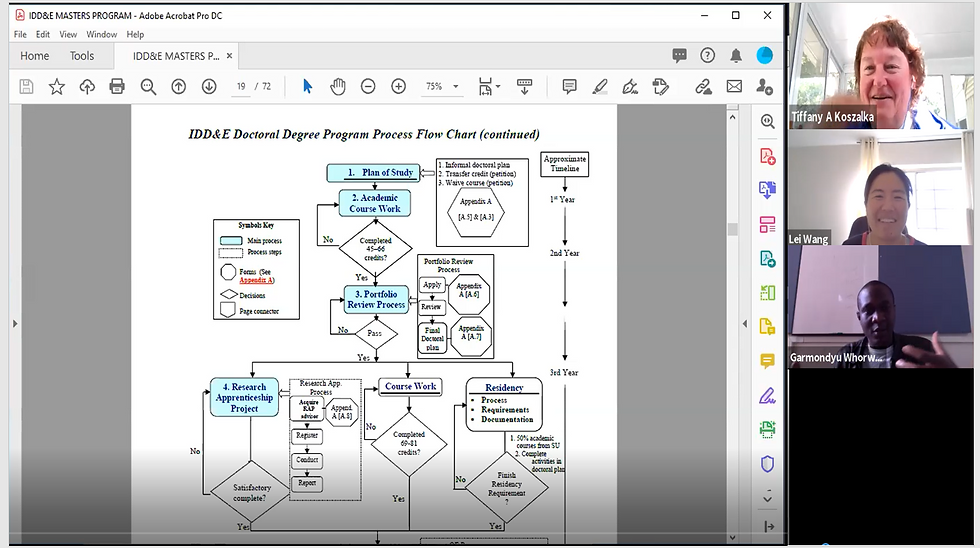
An image taken in the asynchronous class IDE 990 in Fall 2019.
As you review a journal, have you considered finding the latest or emerging trends in your field so that you know if your research interest fits in your field?
Today I would like to reflect on learning in this course throughout the whole semester. Although I took this course last year, the historical timeline has been stuck in my head. I suddenly can answer the question: Why this timeline? In the beginning, I was always wondering why our professor asked us to read about the history of instructional design. It seemed like it didn't have a close relationship with doing research.
Just after the last meeting, I had my "aha" moment when I read the Big History Project our professor had mentioned previously. I still remember feeling stunned. Like projects, people can make a difference. A timeline can be a project, a record, as well as the theme of our course. Every task we did was an exceptional timeline. Taking our professor’s class really keeps my eyes wide open.
By reflecting on the historical research of instructional design, I became aware of the development of our field. I could even trace Individualized Instruction plans back to their development in the 1920s. They allowed learners to progress at their own pace with minimum teacher direction. That was exactly one of the teacher's strategies to self-regulate learners, and we still use it now. Many theories and principles we use today developed between the 1950s and 1970s. Previous research had been conducted based on learning. The future trend would still be focused on instructional practices that teachers could use to facilitate students’ learning. As time goes on, there might be some reforms to meet the current learning environment. More educational practices would be integrated into theoretical frameworks. The other trend is technology-based learning instruction. As technology develops, people can use it to better help students in the learning process. With the development of simulation, robot program, IR, VR, IVR and AI, how can we take advantage of them and create a better learning environment and support students to reach a higher level of learning and thought? Educators should be skilled at incorporating technology when approaching a problem and solving it using reasoning, creativity, and expression, as well as providing a new way to demonstrate content knowledge.
Future models should be designed based on the age of information, the explosion of knowledge, and the need for technologies. They should accommodate a range of developer expertise and practice, from extremely simplified to high complex and sophisticated approaches. The instructional design field will be focusing more on construction of personal experience than on skills development and knowledge acquisition.
By working on the work plan with Garmondyu and critiquing the historical timeline of peers' projects, I hone my skills and build my competencies in both my professional development and project management. Both the practice and review of the ADDIE model and project management prompted me to learn strategies for creating artifacts and acquire abilities of the implementation and management of the overall design process. Instructional design theories and research-based principles of instruction help me develop my design thinking and to use instructional design processes to inform my strategic work processes, activities and technical tools or equipment that best support learning and instruction.
Reviewing journals is another timeline task. It also helped me develop the habits of reading journals and finding trends in our own research field. We review what happened in the past and predict the future to see where we can fit in the field. Based on the journals I have reviewed, some of the current instructional design trends are influenced by technology advances in social media and big data. Most of the articles related to self-regulated learning in the past five years are about the investigations on the effectiveness of new programs or interventions. As time goes by, researchers tend to use very specific strategies instead of big categories. Take the journal Instructional Science as an example. 2 articles published in the journal in 2019 are related to self-regulated learning. One is on the value of fixed versus faded self-regulatory scaffolds on fourth graders' mathematical problem solving. This quasi-experimental study of fourth-graders examined the effectiveness of metacognitive self-question prompts in a Fixed (continuous) versus Faded (graduated reduction) scaffolds model during planning, monitoring, and reflection phases, on the facilitation of students’ SRL (metacognition, calibration of confidence judgment, motivation), and sense-making of mathematical problem solving at the end of the program (short-term effect) and 3 months later (long-term/lasting effect).
This study didn’t talk about scaffolding strategy itself, but focused on a fixed continuous practice (e.g., metacognitive question prompts), which is the fading role of scaffolding to prepare autonomous learning. A unique approach for fading that offers a graduated reduction model of scaffolding prompts according to the SRL phases involved in the solution, which allows assimilation of processes to prepare learners for autonomous activity and in the long-term retention effect.
The other is fostering creative performance in art and design education via self‑regulated learning. The authors of this article chose from a large number of creative performance pedagogical practices to foster self-regulated learning (SRL). They were trying to identify the ways art and design professors enacted practices that foster their students’ self-regulation during learning and performance. They focused on creativity and higher-order thinking processes.
By developing the timeline of the historical research on self-regulated learning, I came to understand how this theory evolved through 4 different groups of studies in earlier stages. One historic group of studies focused on metacognitive and cognitive analysis. For example, students were frequently taught to use a strategy to enhance learning, such as constructing a knowledge base for mastering learning theories. These cognitive strategies usually led to higher levels of learning, even with students in special education classes. These researchers found that these strategies could be learned and transferred to similar problems that were encountered immediately after instruction.
A second historic group of studies focused on self-regulatory processes that are social and motivational in nature. Bandura and his colleagues demonstrated that students’ acquisition and use of learning strategies were influenced by peers’,parents’,and teachers’ modeling. Students’ self-efficacy beliefs about the effectiveness of learning strategies predicted diverse motivational outcomes, such as task interest (Bandura & Schunk, 1981), task choice (Zimmerman & Kitsantas, 1997), and persistence (Schunk, 1984; Zimmerman & Ringle, 1981). Some researchers emphasized how social environments of school and home can be modified personally to enhance the attainment of goals.
A third historic group of self-regulation studies focused on students' use of behavioral or cognitive-behavioral processes to cope with clinical problems, such as hyperactivity and anxiety. These self-control problems often extended to students’ academic functioning, such as procrastination in writing (Beneke & Harris, 1972) and impulsivity during problem solving (Meichenbaum & Gcx)dman, 1971). These studies led to interventions involving the use of self-instruction (Meichenbaum, 1977), self-rewards, and self-punishment (Jackson & Van Zoost, 1972) to improve students’ academic functioning.
A fourth historic group of studies of SRL dealt with developmental issues. To enhance children’s self-regulation, developmental researchers provided self-verbalization training as a scaffold within children’s zone of proximal development (ZPD). Publications suggest that children’s development of self-regulation can be attributed to changes in the regulatory processes themselves (e.g., goal setting and strategy use) as well as to biological and experiential factors.
Earlier studies seem to have different and separate research questions, processes and directions; however, as I read more, I found they had something in common with more recent studies: they formulated definitions, frameworks, identified key self-regulatory processes, investigated the relationships between SRL and achievement outcome, and developed research methodologies.
Based on my research interest, I was thinking that if I focused on teachers’ instruction to enhance students’ self-regulated learning, I should think about the definition within this domain. Many researchers currently defend the view that a major goal of formal education should be to equip students with self-regulatory skills. These skills are viewed as vital, not only to guide one's own learning during formal schooling, but also to educate oneself and up-date one's knowledge after leaving school. This conforms to my hypothesis.
Considerable empirical evidence attests to the positive impact of SRL, not only in schooling, but also in life-long learning (van Beek et al. 2014; Kuo 2010). It is a demanding requirement of teachers to teach students to become autonomous and metacognitive learners (Nykiel-Herbert 2004). Futhermore, as I mentioned before, rooted in Chinese culture and nurtured by Confucius and Confucians, developing life-long learning skills has been one of my major concerns as an educator.
Along with this domain of my research, self-regulated learning (SRL) should be defined as a multidimensional construct that involves cognitive, metacognitive, motivational, and social aspects of learning. I reviewed the models that can be used as a reference for my framework. I found that Boekaerts (1996b) developed a structural model, as you can see on this slide in 1996, which is suitable for my study. Self-regulation was divided into six components: (1) domain-specific knowledge and skills, (2) cognitive strategies, (3) cognitive self-regulatory strategies, (4) motivational beliefs and theory of mind, (5) motivation strategies, and (6) motivational self-regulatory strategies (Boekaerts, 1996b).
I partly changed my context because I conducted a survey design in China in Dr. Cho’s class. Teachers at some point develop their own beliefs about the promotion of self-regulation based on their teaching experience, so it is important to shape teachers' beliefs before this happens. Training should take place as early as possible. I am thinking about doing research on pre-service teachers instead of in-service teachers here in the US.
Empirical studies have also shown the evidence that teachers need to receive training on SRL theory and models to understand how they can maximize their students’ learning (Paris and Winograd, 1999; Moos and Ringdal, 2012; Dignathvan Ewijk et al., 2013). Pre-service teachers should receive pedagogical training for their future adaptation to the workplace. Teachers also should gain SRL expertise themselves as learners, as this will impact their knowledge and pedagogic skills (Moos and Ringdal, 2012).
Understanding these new directions and methods in our field, I feel more comfortable and confident undertaking my own research.

Comments